
Slats | Purlins | Knots
To mark the centenary of Bauhaus Dessau, the outdoor exhibition “Slats | Purlins | Knots” in front of the Junkers’ boathouse tells the remarkable story of a German–Turkish joint venture in which Junkers and his lamella halls played a decisive role.
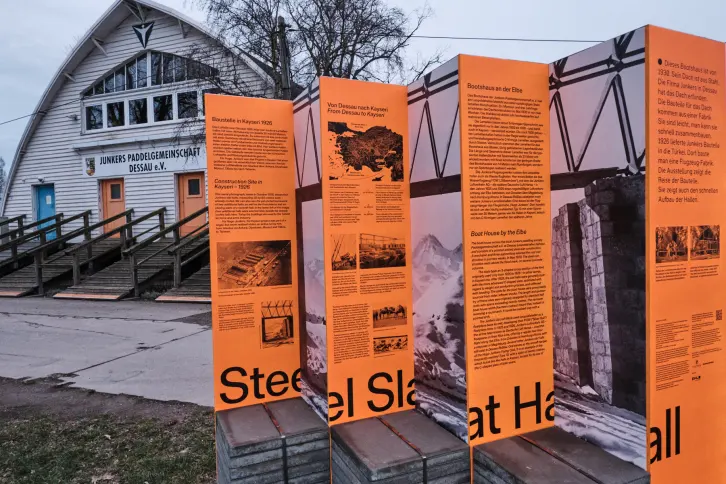
What had proved its worth in Dessau could also be exported. When the young Turkish Republic sought to build its own aviation industry in the 1920s, Junkers was ready. In 1925, both sides jointly founded TOMTASCH – the Turkish Aircraft and Engine Company – and set about constructing an aircraft factory comprising eleven Junkers lamella halls. The Turkish military selected a site near the city of Kayseri in the central Anatolian highlands, some 300 kilometres south-east of Ankara. Raw materials and labour were available there, and the city had in any case long been earmarked as a location for the arms industry.
Camels Instead of Lorries
The logistics were formidable. The components travelled by ship from Dessau to the Turkish port of Mersin – including a three-week delay due to stormy seas. There, the only available crane broke down, and everything had to be unloaded by hand. As Kayseri was not yet connected to the railway network, the train journey through the Taurus Mountains ended after 150 kilometres at the small town of Ulukışla. The remaining 200 kilometres to the construction site were covered by camels and mules – far more reliable than the four small lorries available, which made no headway on the waterlogged track. Despite all the adversity, the first hall was standing within a matter of weeks. Yet the project was by then already close to collapse. The German side failed to honour its promise to train Turkish nationals as aviation experts. The Turkish side, for its part, feared that Junkers might be nationalised, and continued to prefer buying aircraft from France. Moreover, the halls proved too narrow for newer aircraft types with greater wingspans. By 1928 the capital was exhausted, and TOMTASCH went into insolvency.
The halls, however, are still standing today – as part of a modern aircraft maintenance centre and as a historic site of the Turkish aviation industry.
Tip
If you’re planning to visit the anniversary exhibition “Bauhaus Dessau 100 – To The Core”, are travelling from out of town and are looking for affordable accommodation: The Junkers Paddling Club runs a campsite.