
A Listed Junkers Building
The boathouse of the Junkers Paddling Club, built in 1930 at Leopoldshafen, is a listed building. The reason is its roof construction of steel lamellae.
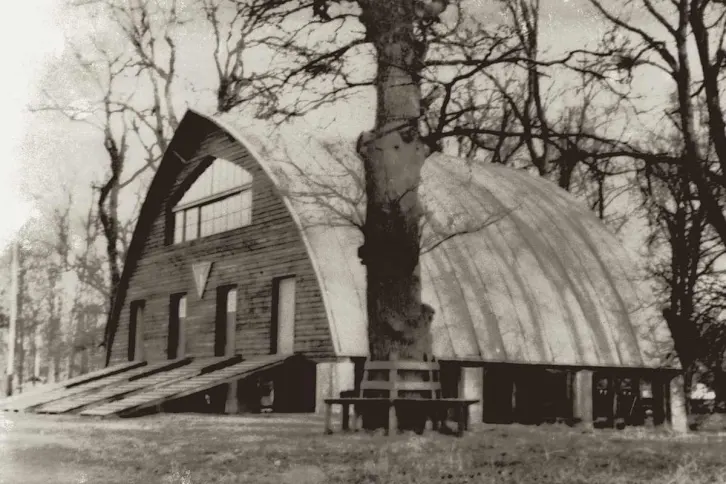
The principle had been developed by the aviation pioneer, engineer and entrepreneur Hugo Junkers in the mid-1920s. In doing so, he transferred principles he knew from aircraft construction: thin metal sheets, stiffened through corrugations, flanges and curvatures in such a way that they achieve maximum stability with minimal use of material.
And what worked for wings was to prove transferable to hall roofs. The first prototype was a small petrol shed on the factory premises, erected in 1925. An official load test confirmed the viability of the construction. Series production could begin.
Zollinger's Patent
What Junkers had, however, overlooked – or chosen to ignore – was that someone had got there first. Friedrich Zollinger, municipal building surveyor in Merseburg, had developed a similar lightweight construction and marketed it with considerable success. (200 kilometres upstream along the Elbe stands a boathouse with a Zollinger roof.)
Zollinger used timber rather than steel, but noted explicitly in his patent application that the construction could equally be executed in steel. After lengthy disputes, an out-of-court settlement was reached, and the Junkers system was henceforth marketed under the name Junkers–Zollbau lamella roof.
Worldwide Marketing
The steel lamella roofs were sold worldwide. Of the many halls and roof structures built with them, only a few survive today, most of them probably in Dessau. One serves as a glider hangar at the local airfield. The steel lamella construction was also used at the Dessau waterworks. Saved from complete dereliction – though its future remains uncertain – stands a hall on the site of the former Junkers Kaloriferwerk.
Further halls can be found, among other places, in Leipzig and Zwischau, and at the airfields in Oberschleißheim near Munich, Heston near London, and not far from the English town of Shrewsbury. In Liverpool, a steel lamella hall was converted into a spectacular office building, the Skyway House.
Leftover Stock and a Ridge
The roof of the Junkers boathouse is a notable exception: it is formed as a pointed arch, whereas gently or more pronouncedly curved round arches were otherwise the norm. The reason: the building was too narrow; at just over 14 metres in width, the roof construction could not be executed as a round arch. A “kink” at the ridge helped to reduce the span.
The lamellae used in the Junkers boathouse have an S-shaped cross-section – a form that Junkers employed only between 1925 and 1928, before it was superseded by lighter, C-shaped lamellae. They most likely came from older stock. This makes the boathouse a rare surviving example from the early production phase.
Aluminium Corrugated Sheet for the Doors
The very lightweight roof construction uses standardised lamellae, gusset plates and purlins – components deployed worldwide in the construction of industrial halls and hangars, capable of spanning widths of up to 40 metres. As thermal insulation for his lamella halls, Junkers recommended a peat-based product known as Torfoleum, which was also used in the Bauhaus buildings in Dessau – though at the boathouse itself, thermal insulation was of no concern. That steel lamellae came to be used at a boathouse in Dessau of all places was no coincidence: not only had Junkers developed and built aircraft in Dessau until his expropriation by the Nazis, earning worldwide renown in the process, but the boathouse belonged to a works sports club – none other than the Junkers Paddling Club, which exists to this day.
Alongside the roof construction, another detail recalls Junkers: the doors of the original lockers are made from the same aluminium corrugated sheet that was for so long the hallmark of Junkers aircraft.
Canoeing as a Popular Pastime
The canoeists' boathouse was built in May 1930, as reported in the Junkers works magazine, issue 3/1930. A fitter and three Junkers apprentices erected the lamella construction in just two weeks. In the journal of the canoe federation, one Engineer E. J. Ritter, contemplating the new clubhouse, said it reminded him of “the boathouses of the natives on the South Sea islands” – offering, in his view, a counterpoint to “civilisational degeneration”.
Be that as it may: when the Junkers boathouse was built, canoeing in Germany was something close to a national pastime. Paddle boats were even built in the Junkers training workshops – anyone who looks at the construction of an F 13 or a Ju 52 and compares it with the boatbuilding methods of the time will sense that more than sporting considerations were at play.